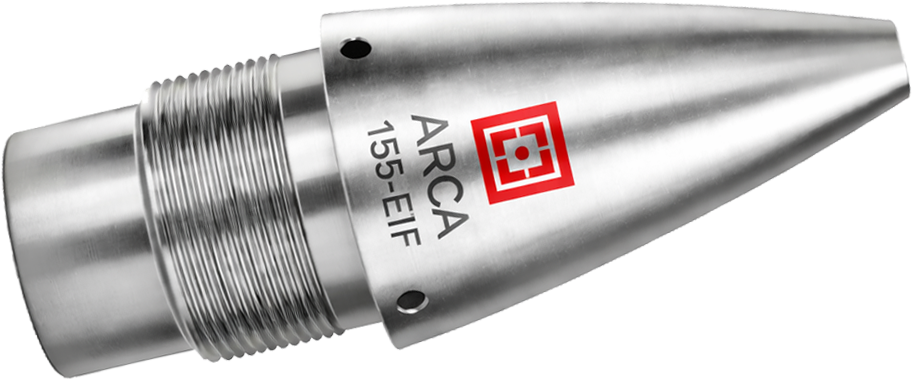
Super Quick Impact Fuze
The ARCA 155 EIF is a high-precision, high-reliability Super Quick Impact Fuze designed for modern 155 mm artillery ammunition.
Engineered for instant detonation upon target contact, it delivers maximum lethality, fast response time, and exceptional performance against a wide range of targets.
Its rugged mechanical body is specifically designed to withstand extreme firing shocks, high spin rates, and harsh environmental conditions.
Technical Specifications
- Compliance Standard: STANAG 2916
- Minimum Arming Requirements: ≥ 1,000 G setback + ≥ 2,000 RPM spin
- Total Length: 153.13 mm
- Weight: 770 ± 50 grams
- Compatible Ammunition: M107, MOD274, and other 155 mm artillery rounds
- Firing Shock Resistance: 1500 G
- Operating Temperature: –32 °C to +50 °C
- Storage Temperature: –54 °C to +71 °C
- Shelf Life: 10 years
KEY Advantages
High-Precision Impact Activation
Provides instantaneous detonation at the exact moment of target contact, ensuring maximum penetration and destructive effect.
- Dual-Safety Arming Logic
- Rugged Mechanical Construction
- STANAG-Compatible Interface
Robust Environmental & Shock Tolerance
Designed to withstand severe launch conditions of 122 mm rockets, including high vibration, temperature changes, and mechanical shock.
Fail-Safe Arming Mechanism
The fuze arms only when both conditions are met:
- ≥ 20 G setback
- ≥ 400 RPM spin
This ensures absolute safety during handling, storage, and transport.
Detonation / Trigger Mode
Super Quick Impact Mode
Detonates immediately upon physical contact with the target surface. This ensures rapid energy transfer and optimal lethality against structures, fortifications, and ground impact targets.
Safety and Durability
Environmental Reliability
Performs flawlessly in heavy rain, humidity, vibration, and harsh battlefield conditions.
High Structural Integrity
Reinforced mechanical components ensure dependable operation even during high-intensity firing sequences
Fail-Safe Arming Mechanism
The fuze arms only under true ballistic launch conditions, meeting both the 1,000 G setback and 2,000 RPM spin requirements simultaneously.